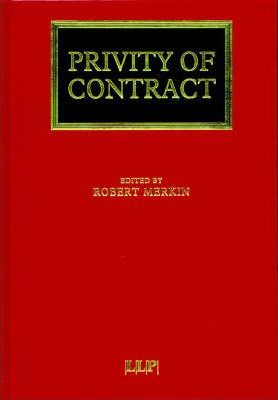
Doctrine of Privity

The basic Doctrine of Privity is that only parties to a contract may enforce that contact and that a third person who is not a party to the contract may not, unless he can take advantage of one of the limited exceptions to the doctrine, enforce a contact to which he is not a party even if that contract is made for his benefit. For example, if A promises B that A will pay $100 to C if C performs a piece of work, C, having performed the relevant piece of work, cannot sue A for the $100. (Interestingly, in this example, B could also not compel A to pay the $100 to C as B has supplied no consideration for A’s promise unless the facts are such that B agreed to procure performance by C.

It is generally agreed that the modern doctrine of privity was established in 1861 in Tweddle v. Atkinson. In that case the fathers of a groom and bride, in pursuance of an oral contract made between the fathers before their children’s marriage, agreed together in writing to pay the groom, in one case £200 and in the other case £100, adding that the groom should have full power to sue them in any court of law for those sums. The bride’s father failed to pay and the groom, who was not a party to the contract between the fathers, sued the bride’s father for the payment promised by the bride’s father under the contract. The groom’s claim was dismissed on the basis that no stranger to a contract could take advantage of that contract even though made for his benefit.

The Doctrine of Privity was approved by the House of Lords in Dunlop Pneumatic Tyre Co. Ltd. v. Selfridge & Co. Ltd. in 1915 where Lord Haldane said:

“In the law of England certain principles are fundamental. One is that only a person who is a party to a contract can sue on it. Our law knows nothing of a jus quaesitum tertio arising by way of contract. Such a right may be conferred by way of property, as for example, under a trust, but it cannot be conferred on a stranger to a contract as a right to enforce the contract in personam”.

This, however, cut little ice with Lord Denning who made several attempts in the 1950’s to allow rights of suit by third party beneficiaries; despite this, however, the House of Lords reaffirmed the general Doctrine of Privity in Midland Silicones Ltd. v. Scruttons Ltd. (Lord Denning dissenting) in 1962.

WARNING: The Doctrine of Privity is an area of the law where concepts of equity or fairness have little or no standing whatsoever. If A promises B that if B (or C) will do something A will pay a cash sum to C there is no equity in the rule that says that C cannot enforce this promise; but that is currently the law so if you wish to confer an enforceable benefit on a stranger to a contract you must make use of one of the exceptions to the Doctrine of Privity and not simply rely on vague concepts of equity/clean hands and all that.

Joint Obligations

A joint promise by two or more persons creates a single obligation upon both or all. The theory of a joint and several promise is that it creates both a joint obligation incumbent upon all and a number of several obligations respectively incumbent upon each one; but the several obligations are non cumulative, so that (as with purely joint obligations) performance by any one will discharge all. The presumption is that a contract made by two or more persons is joint, express words being necessary to make it joint and several: Glanville Williams, Joint Obligations (1949), Butterworths at 24; see too Re Hodgson (1885) 31 Ch D 177 at 188.

The fact that an obligation is joint does not mean that a joint obligor is only partly liable for the amount of the obligation.

A successful plaintiff is entitled to enter judgment for the full amount of its proven claim but is not entitled to double recovery. Payments effect a reduction in the amount of the liability of each defendant.


Junker v Hepburn [2010] NSWSC 88 [52]-[54]

Actual and Ostensible authority

See the principles in relation to actual and ostensible authority in Junker v Hepburn [2010] NSWSC 88 (Junker) at [39]-[48] (Hammerschlag J)

Agency

39 The authority of an agent may be:

  • actual (either express or implied) where it results from a manifestation of consent that the agent should represent or act for the principal expressly or impliedly made by the principal to himself; or
  • apparent, where it results from such a manifestation made by the principal to third parties: Bowstead and Reynolds on Agency, 17th ed (2001) Sweet & Maxwell at Ch 3, Art 22.

40 The rules concerning actual and apparent authority apply where the principal is a company. They are supplemented by provisions of the Act where companies are concerned. The usual starting point in any consideration of a director’s actual authority is the constitution of the company, which invariably provides for directors’ powers. Express actual authority of a director usually derives from the constitution of the company or from some antecedent act such as a resolution of the board of directors: Northside Developments Pty Ltd v Registrar-General (1990) 170 CLR 146 at 205; Perkins v National Australia Bank Ltd (1999) 30 ACSR 256 at 262.
41 Implied actual authority is the authority which the law regards as having been given to an agent because of the interpretation put by the law on the relationship and dealings of the two parties: Bowstead and Reynolds on Agency, 17th ed (2001) Sweet & Maxwell par 3-003. The Court’s inquiry concerns the intention of the principal in conferring authority on the agent: Gino Evan Dal Pont, Law of Agency, 2nd ed (2008) LexisNexis Butterworths par 8.1.
42 Ordinarily, where a company has more than one director, a single director does not have authority to bind it. A director’s normal power is to bind the company only by joining with other directors in a collective resolution of the board of directors: Northside Developments Pty Ltd v Registrar-General (1990) 170 CLR 146 at 198, 205.
43 An implied grant of actual authority can result from acquiescence in the course of behaviour by persons who have actual authority to delegate. For example, if directors as a board stand by whilst a single director enters into transactions outside his or her authority, the board’s acquiescence in that course of dealing can constitute the grant, by implication, of actual authority to enter into those transactions.
44 In Equiticorp Finance Limited (in liq) v Bank of New Zealand (1993) 32 NSWLR 50 at 134, Clarke JA and Cripps JA said in relation to implied actual authority:

A recent example of the application of the principle in Australia is to be found in Brick and Pipe Industries Ltd v Occidental Life Nominees Pty Ltd [1992] 2 VR 279, where (at 360-361) the Appeal Division of the Supreme Court of Victoria applied Hely-Hutchinson v Brayhead Ltd . In the joint judgment there was a finding of implied actual authority in relation to one Goldberg to manage the business and to hold out a person as secretary who  was in fact not the secretary. The facts and circumstances there relied upon to justify such a finding included the following: Goldberg had actual control over the group of companies and invariably asserted control over each of the companies in the group; Goldberg was known as the alter ego of group companies; Goldberg made decisions for the group companies; there was no evidence that he found it necessary to refer to any board to seek approval for the course of action he proposed; the boards in question had never previously attempted to interfere with his action; Goldberg had obtained board approval of transactions to which he had already committed Brick and Pipe without first seeking authorisation from the board; and that individual directors in evidence confirmed the acquiescence of board members in the activity of Goldberg which culminated in completed transactions for which the board gave no prior approval. One final and, perhaps, decisive element in the scope of the authority the court was prepared to find vested in Goldberg, was that: “… in most, if not all, cases, the transactions committed assets of Brick and Pipe or its subsidiaries as security for borrowings by other Goldberg companies”.

Whether authority is to be implied and, if so, the scope of the authority implied is, in our view, to be found in a close analysis of the evidence before the court which is relied upon to support the implication of actual authority.

45 The authors of Company Directors: Principles of Law and Corporate Governance (2005), LexisNexis Butterworths at par 3.41, citing Freeman & Lockyer v Buckhurst Park Properties (Mangal) Ltd [1964] 2 QB 480 opine that to confer implied actual authority there would have to be not only the acquiescence of the individual board members but evidence of communication by word or conduct of their respective consents to one another and to the agent.
46 Apparent or ostensible authority is conferred where a principal represents that another has authority. The principal will be bound as against a third party by the acts of that other person within the authority which that person appears to have, though the principal had not in fact given that person such authority or had limited the authority by instructions not made known to the third party: Pacific Carriers Ltd v BNP Paribas (2004) 218 CLR 451 at 466; Bowstead and Reynolds on Agency, 17th ed (2001) Sweet & Maxwell par 3-005.
47 Ostensible authority often coincides with, but sometimes exceeds, actual authority. For instance, when a board appoints a managing director, they may expressly limit his authority, but his ostensible authority will include all the usual authority of a managing director. The company is bound by his ostensible authority in his dealings with those who do not know of the limitation: Hely-Hutchinson v Brayhead Ltd [1968] 1 QB 549 at 583 per Lord Denning M.R.
48 An ordinary individual director of a company does not have ostensible authority to bind it. Directors can act only collectively as a board and the function of an individual director is to participate in decisions of the board. In the absence of some representation made by the company, a director has no ostensible authority to bind it: Northside Developments Pty Ltd v Registrar-General (1990) 170 CLR 146 at 205.
Contract law series – seminar 12 – Vitiating factors – misrepresentation, misleading and deceptive conduct

Seminar 12 in the Contract Law Series – Vitiating factors – misrepresentation, misleading and deceptive conduct.

This is a presentation to unversity-level students in Contract Law by Dr William Higgs, Barrister-at-law, Elizabeth Street Chambers, Sydney, Australia.

This is teaching material. No warranty is given about the accuracy of the information contained. This presentation is updated from time to time.

Seminar 12 – Vitiating Factors – Misrepresentation, Misleading and Deceptive Conduct

Contract law series – seminar 11 – Estoppel and vitiating factors

Seminar 11 in the Contract Law Series – Estoppel and vitiating factors.

This is a presentation to unversity-level students in Contract Law by Dr William Higgs, Barrister-at-law, Elizabeth Street Chambers, Sydney, Australia.

This is teaching material. No warranty is given about the accuracy of the information contained. This presentation is updated from time to time.

Seminar 11 – Estoppel and vitiating factors (mistake)

Contract law series – seminar 10 – Repudiation, frustration and delay

Seminar 10 in the Contract Law Series – Repudiation, frustration and delay.

This is a presentation to unversity-level students in Contract Law by Dr William Higgs, Barrister-at-law, Elizabeth Street Chambers, Sydney, Australia.

This is teaching material. No warranty is given about the accuracy of the information contained. This presentation is updated from time to time.

Seminar 10 – Repudiation, frustration & delay

Contract law series – seminar 7 – Performance, breach and termination

Seminar 7 in the Contract Law Series – Performance, breach and termination.

This is a presentation to unversity-level students in Contract Law by Dr William Higgs, Barrister-at-law, Elizabeth Street Chambers, Sydney, Australia.

This is teaching material. No warranty is given about the accuracy of the information contained. This presentation is updated from time to time.

Seminar 7 – Performance, classification, breach & termination

Contract law series – seminar 3 – Consideration

Seminar 3 in the Contract Law Series – Consideration.

This is a presentation to unversity-level students in Contract Law by Dr William Higgs, Barrister-at-law, Elizabeth Street Chambers, Sydney, Australia.

This is teaching material. No warranty is given about the accuracy of the information contained. This presentation is updated from time to time.

Seminar 3 – Consideration