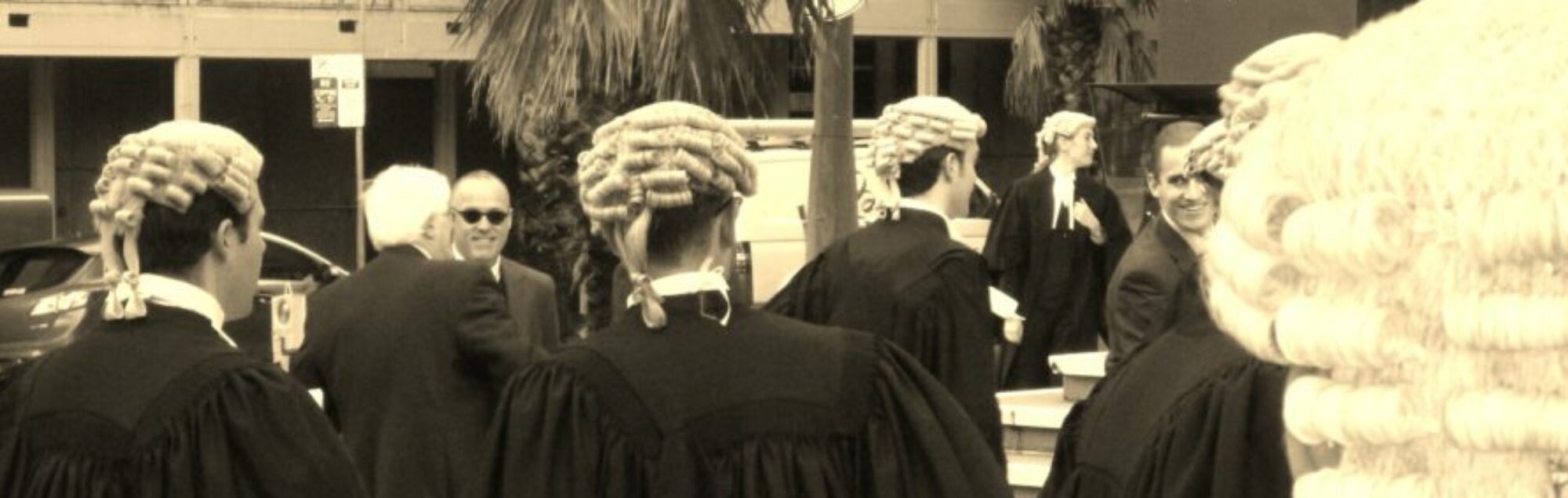
Legal principles: Mingling trust funds and onus

Mingling trust funds and onus (from [2018] NSWSC 1987)

  1. The fiduciary obligations arising if a trustee mingles or mixes trust funds with non-trust funds were explained in Cook v Addison(1869) LR 7 Eq 466 (at 470):

It is a well-established doctrine in this court, that if a trustee or agent mixes and confuses the property which he holds in a fiduciary character with his own property, so as that they cannot be separated with perfect accuracy, he is liable for the whole.

  1. This was applied by Ungoed-Thomas J in Re Tilley’s Will Trusts; Burgin v Croad [1967] Ch 1179 who said (at 1183) (citations omitted):

The words in that passage “so as that they cannot be separated with perfect accuracy” are an essential part of the Vice-Chancellor’s proposition, and indeed of the principle of Lupton v White. If a trustee mixes trust assets with his own, the onus is on the trustee to distinguish the separate assets, and to the extent that he fails to do so they belong to the trust.

  1. In Foskett v McKeown [2001] 1 AC 102; [2000] UKHL 29 Millett LJ said (at 133) (citations omitted):

The rule in equity is to the same effect, as Sir William Page Wood V-C observed in Frith v Cartland: “if a man mixes trust funds with his own, the whole will be treated as the trust property, except so far as he may be able to distinguish what is his own”.

  1. Australian courts have accepted these principles: Brady v Stapleton (1952) 88 CLR 322 at 336-9; [1952] HCA 62 (Dixon CJ and Fullagar J) and Hospital Products Ltd v United States Surgical Corporation (1984) 156 CLR 41 at 109-10; [1984] HCA 64 (Mason J).
  2. In Raulfs v Fishy Bite Pty Ltd [2012] NSWCA 135 Campbell JA (with Meagher and Barrett JJA agreeing) said (at [95]):

Because Mr Chincotta paid various sums of money not derived from Heperu into the Westpac accounts, Allsop P held at [112] that the funds in that account were a mixture of trust funds and personal funds of the effective defaulting fiduciary, Mr Chincotta. Trust money that passes through a mixed fund can be traced into an asset that is still in existence when a court considers the matter. This arises through application of the principle that a defaulting trustee who withdraws from a mixed fund and dissipates the withdrawal is presumed to have dissipated his own money. Thus, it was open to Heperu to trace the trust funds from the mixed fund into any asset that had been purchased from the mixed fund: Scott v Scott (1963) 109 CLR 649 at 664. Further, if a withdrawal from the mixed fund was used to discharge a mortgage over real estate, tracing into that real estate could be effected by reason of Heperu being subrogated to the proprietary right of the mortgagee whose mortgage was paid out: Boscawen v Bajwa [1996] 1 WLR 328 at 340-1Heperu v Belle at [135].

Novel duty of care

An interesting decision of the NSW Court of Appeal on the topic of recognition of a novel duty or care.

Ibrahimi v Commonwealth of Australia [2018] NSWCA 321

The Court of Appeal has dismissed an appeal from Mr Ibrahimi, representing a class of persons, against the Commonwealth of Australia concerning an alleged breach of duty of care owed to the plaintiffs during the shipwrecking of the boat on which they were travelling, SIEV 221, off the coast of Christmas Island in December 2010.

The Court (Payne JA, Meagher JA and Simpson AJA agreeing) (consistent with the primary finding at first instance) held that any alleged duty could not arise under the established categories of duty. Rather, any duty would have to arise as a novel duty of care, in which case the application of the salient features test is the correct approach.

On the facts of he case, there was no relevant reliance by the group members on the Commonwealth which would give rise to the relevant vulnerability, nor did the Commonwealth have control over the risk to the the group members in the relevant sense. In addition, there is no expectation placed on public authorities, of which the Commonwealth was one, of general reliance: that an entity will properly perform its public or private function.

It is important to note that this particular case dealt with potential harms flowing from omissions by a public authority, not from positive acts by such public authority. These aspects operate to mitigate against imposing a duty of care of a novel kind.

Finally, a $2 coin to the primary judge, on a difficult legal issue and emotionally charged issue, who was correct to reject case brought by Mr Ibrahimi.

How to construe an insurance policy

From: Muriniti; Newell v Lawcover Insurance Pty Ltd (No 2) [2018] NSWCA 311 beginning at [39]

Legal principles

The principles governing the construction of insurance policies are well established and were not in dispute. In McCann v Switzerland Insurance Australia Ltd (2000) 203 CLR 579; [2000] HCA 65, Gleeson CJ stated, at [22]:

“A policy of insurance, even one required by statute, is a commercial contract and should be given a businesslike interpretation. Interpreting a commercial document requires attention to the language used by the parties, the commercial circumstances which the document addresses, and the objects which it is intended to secure.” (footnotes omitted)

This statement was cited with approval by the High Court in Wilkie v Gordian Runoff (2005) 221 CLR 522; [2005] HCA 17 at [15], the Court adding, at [16]:

“In construing the policy, as with other instruments, preference is given to a construction supplying a congruent operation to the various components of the whole.” (footnote omitted)

In Zhang v ROC Services (NSW) Pty Ltd; National Transport Insurance by its manager NTI Ltd v Zhang (2016) 93 NSWLR 561; [2016] NSWCA 370 Leeming JA observed, at [86]:

“Where there is more than one available legal meaning, a court looks at the text, context and purpose, with a view to determining which potential meaning best accords with those considerations. Sometimes, text, context and purpose all point in the same direction, and all support the same conclusion as to the legal meaning of the contractual provision; that was the case in Victoria v Tatts Group Ltd (2016) 328 ALR 564; [2016] HCA 5 at [51] and [75]. Sometimes, as here, text, context and purpose point in different directions. But it remains necessary to assess the potentially available legal meanings against those matters.”

Leeming JA found the observations of Mance LJ in Gan Insurance Co v Tai Ping Insurance Co Ltd (No 2) [2001] EWCA Civ 1047; [2001] 2 All ER (Comm) 299 of assistance where there is a constructional choice as to the proper meaning of a contract or a term of a contract. In Gan Insurance Co v Tai Ping Insurance Co Ltd (No 2), the concern was with a clause which had at least two possible meanings. Mance LJ stated, at [16]:

“… In these circumstances, it is especially important to undertake the exercise on which the judge declined to embark, that is to consider the implications of each interpretation. In my opinion, a court when construing any document should always have an eye to the consequences of a particular construction, even if they often only serve as a check on an obvious meaning or a restraint upon adoption of a conceivable but unbusinesslike meaning.”

This passage was unanimously approved by the United Kingdom Supreme Court in Rainy Sky SA v Kookmin Bank [2011] 1 WLR 2900; [2011] UKSC 50; at [26]. See also the observations to the same effect in Australian Broadcasting Commission v Australasian Performing Right Association Ltd (1973) 129 CLR 99; [1973] HCA 36 per Gibbs J at 109, upon which the primary judge relied:

“It is trite law that the primary duty of a court in construing a written contract is to endeavour to discover the intention of the parties from the words of the instrument in which the contract is embodied. Of course the whole of the instrument has to be considered, since the meaning of any one part of it may be revealed by other parts, and the words of every clause must if possible be construed so as to render them all harmonious one with another.”

Deed poll vs deed inter-parties?


The difference between a deed poll and a deed inter partes is absolutely crucial because of the difference as to who may enforce the deed in question.

It is clear that any person named or sufficiently indicated in a deed poll may sue to enforce any obligation undertaken in that deed poll in his favour despite the fact that he is, by definition, not a party to the deed poll and has not executed the deed poll.

By contrast however a person cannot sue on a covenant made in his favour which is contained in a deed inter partes unless he is a party (and named as a party) to the relevant deed. Even if a third party executes a deed inter partes he cannot sue on it unless he is named as a party to the deed. The only way in which a person who is not a party to a deed inter partes can enforce a covenant in his favour contained in that deed is to come within one of the exceptions to the Doctrine of Privity e.g. he would be able to enforce the covenant if he was able to show that there was a completely constituted trust of the covenant in his favour.

Consequently it is vital where you are preparing a deed poll which is to be enforceable by third parties that you do not use language which suggests that there is more than one party to the deed and that it is a deed inter partes. For example avoid phrases such as “this deed is made between”. Conversely, if you are preparing a deed inter parties, make sure that any person who you wish to be able to enforce the deed is named as a party (unless one of the named parties is to be a trustee of the benefit of the deed for a third party beneficiary).

The other historical distinction was between a deed poll and an indenture. Whereas a deed poll, made by one party only, had a shaved or “polled” edge, an indenture, which was a deed to which two or more persons are parties and which evidenced some act, bargain, contract, conveyance, covenant or agreement between them other than the mere consent to join in expressing the same active intention (i.e. the joint and several guarantors example above), was a deed with serrated or indented (hence the term “indenture”) edges so that each party had a similar deed with the two parts being supposed to fit together as a sort of a tally.

The practice of indenting originated in early times when deeds were short; often a deed between parties would be written out two or more times (according to the number of parties) on a single sheet of parchment which was then divided by cutting it with an irregular edge so that each part could be fitted into the other to demonstrate its authenticity.

At first this rule was very strict and a deed executed before 1845 was not an indenture unless it was actually indented, even though it was stated to be an indenture. However in 1845 legislation in the UK was passed providing that a deed between parties has the effect of an indenture even though the parchment on which it is written was not actually indented.

Consequently for all practical purposes the term “indenture” is now a thing of the past and the only real important differentiation nowadays is between deed polls and deeds inter partes.

What is a Deed Poll?

It is a basic rule of Australian contract law that, save for limited exceptions, a contract cannot confer rights or impose obligations arising under it on any person except the parties to the contract. This basic rule is known as the “Doctrine of Privity” and there are several different aspects of the doctrine namely:

  1. a person cannot enforce rights under a contract to which he is not a party;
  2. a person who is not party to a contract cannot have contractual liabilities imposed on him by that contract; and
  3. contractual remedies are designed to compensate parties to the contract, not third parties

Deed polls constitute one of the limited exceptions to the basic doctrine of privity under Australian law; they are flexible and, provided they are used carefully, can be of great assistance in capital markets and other finance type transactions.

Lets start with a little bit of history. A deed poll is a deed made by and expressing the active intention of one party only, or two or more persons who join together in expressing a common active intention of them all e.g. a deed poll by two or more guarantors whose liability is joint and several.

The name deed poll comes from the fact that historically the parchment required for such deeds had been shaved even or “polled” at the top. This was historically in contrast to an indenture (see below). The most important fact to note in relation to deed polls is that they are the act of one party only (or two or more persons acting together i.e. the joint and several guarantors example above); in essence they are one sided unilateral instruments to which there is only one party not a two sided (bilateral) instrument like a contract.

A deed poll must be distinguished from a deed inter partes and an indenture.

See next Blog deed inter-parties.

Joint Obligations

A joint promise by two or more persons creates a single obligation upon both or all. The theory of a joint and several promise is that it creates both a joint obligation incumbent upon all and a number of several obligations respectively incumbent upon each one; but the several obligations are non cumulative, so that (as with purely joint obligations) performance by any one will discharge all. The presumption is that a contract made by two or more persons is joint, express words being necessary to make it joint and several: Glanville Williams, Joint Obligations (1949), Butterworths at 24; see too Re Hodgson (1885) 31 Ch D 177 at 188.

The fact that an obligation is joint does not mean that a joint obligor is only partly liable for the amount of the obligation.

A successful plaintiff is entitled to enter judgment for the full amount of its proven claim but is not entitled to double recovery. Payments effect a reduction in the amount of the liability of each defendant.


Junker v Hepburn [2010] NSWSC 88 [52]-[54]

Contract Law Series

Seminar 1 in the Contract Law Series – Introduction to Contract Law.

This is a presentation to unversity-level students in Contract Law by Dr William Higgs, Barrister-at-law, Elizabeth Street Chambers, Sydney, Australia.

This is teaching material. No warranty is given about the accuracy of the information contained. This presentation is updated from time to time.

Seminar 1 – Introduction to Contract law

Deed of release – proper construction

It is common ground that the principles of construction of a Deed of Release flow from the decision of the High Court in Grant v John Grant & Sons Pty Ltd [1954] HCA 23; 91 CLR 112 at 123 ff.

(a) [F]irst, the common law requires general words in a release to be construed by reference to the subject-matter of the particular dispute(s) which the recitals said the parties had resolved on the terms of the deed. In this way, ‘the general words of a release should be restrained by the particular occasion’. Regard will be had to the background facts known to the parties, to the nature of the claims made (and proceedings commenced) prior to the release being executed, and the particular objective intent of the parties by whom the release is executed. The intention of the parties ascertained from this process will control the operation of general words in a release. The general words should not be permitted to subvert what the parties should be taken to have intended when the release is properly construed in its context;

(b) secondly, Equity operates to achieve an analogous result. An alleged releasor enjoys an equity ‘to have the general words of a release confined to the true purpose of the transaction ascertained from the scope of the instrument and the external circumstances.’ The ‘state of knowledge of the respective parties concerning the existence, character and extent of the liability in question and the actual intention of the releasor’ will be relevant matters in this context. Equity therefore ‘permits an investigation of the circumstances, including consideration of the actual intentions of the parties, in order to determine whether enforcement of the general words of a release would be against conscience’.”

Also relevant are the observations of Pembroke J in The Owners Corporation of Strata Plan 61390 v Multiplex Corporate Agency Pty Ltd (No 2) [2012] NSWSC 322 at [22] and [30] as follows:

“The principle for which Grant v John Grant & Sons (above) stands is sometimes described more widely than is justified. It is not, and never has been, authority for the proposition that the general words of a release can only ever apply to matters then known to the parties.

…the joint judgment in Grant v John Grant & Sons (above) also recognised that there will always be cases where, properly characterised, the parties should be taken to have intended that the general words of a release should operate to encompass all conceivable further disputes, whether disclosed or not and whether within the knowledge of a party or both parties, or outside of it… In such a case there is no room for the application of equitable principle. The equitable principle only has a role to play when it appears from the terms or the context or other admissible evidence, that the enforcement of the legal right would, by a literal application of the general words of a release, be against conscience. It would not be against conscience if the court is satisfied that the parties intended ‘upon a particular and solemn composition for peace’ to release uncertain demands and presently unknown claims…”. [Citations omitted]

Pembroke J’s observations were endorsed by the Victoria Court of Appeal in Doggett v Commonwealth Bank of Australia [2015] VSCA 351 at [63] per Whelan JA.

Product liability

Source: www.fasterway.com.au

This is a typical fracture surface. This is a threaded connection (hence the appearance of a depression around the circumference).

The fracture surface was smooth, flat, and perpendicular to the principal axis of the bolt. Crack progression marks (beach marks) extended radially from one side of the bolt and covered approximately 90% of the fracture surface area. The remaining small region towards the outer edge of the bolt exhibited features consistent with an overstress failure. The large area of fatigue cracking and small overstress area indicated that failure of the bolt was due to high cycle low stress fatigue cracking.

Bolt fracture surface showing evidence of fatigue crack progression (beach) marks

Bolt fracture surface showing evidence of fatigue crack progression (beach) marks

Source: ATSB

On 30 May 2015, a Fasterway powered parachute, recreational registration 19-7677, collided with terrain near Theodore, Queensland. The pilot, the sole occupant, died as a result of the accident.

Submitted eyenut and fractured bolt

Source: ATSB – Investigation title: Technical assistance to Recreational Aviation Australia in the examination of a fractured eyebolt from the collision with terrain involving a Fasterway Powered Parachute, near Theodore, Qld. on 30 May 2015

Investigation number: AE-2015-075